
The assessment process
When a project has complex approvals, significant impacts, strategic importance or relates to substantial infrastructure it can be assessed to be declared a coordinated project.
At the time of declaration, the Coordinator-General will also determine the type of assessment required:
- an Environmental Impact Statement (EIS)
- Impact Assessment Report (IAR) or
- that environmental effects of the project do not require assessment through an EIS.
The Coordinator-General oversees the assessment process, tailored to the specific nature and scale of each proposed project. For larger projects, this involves an EIS. Smaller, lower-risk projects may require an IAR. Which one applies is determined by the Coordinator-General, based on the application.
Where an environmental impact assessment (EIA) process is required, a ‘project proponent’ engages with the Office of the Coordinator-General to work through the development of an EIA and the steps of the process.
The advantages of the process and being declared a coordinated project includes our experienced team providing:
- information, insights and advice about the assessment process
- a coordinated approach and guidance on local, state and Australian Government (if required) approvals to minimise timeframes
- practical solutions to project issues.
The process also works to ensure potential environmental, cultural and social impacts are identified, assessed and managed effectively.
Find out more about coordinated projects – what they are, the benefits of getting a coordinated project declaration, and find current and completed coordinated projects.
Steps for a coordinated project assessment process
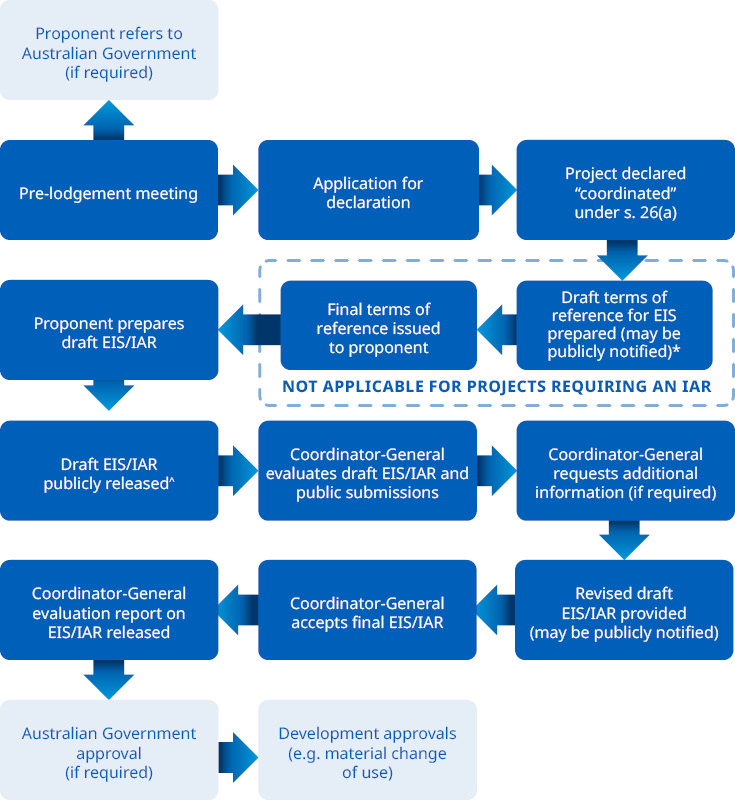
- Pre-lodgement meeting
- Apply for a coordinated project declaration
- Coordinated project declaration
- Prepare Terms of Reference (TOR) for EIS
- Prepare draft EIS or IAR
- Consultation
- Evaluation of draft EIS or IAR and submissions
- Provide revised draft EIS or IAR (if required)
- Evaluation report on final EIS or IAR released
- Application for a project change
1. Pre-lodgement meeting
A free pre-lodgement meeting is strongly encouraged but is not mandatory. It’s an opportunity to discuss in detail the proposed project, get information and advice about our role and to help shape an application. Ideally, this meeting should be held at least 4 weeks before lodging an application.
Topics that can be discussed include:
- the assessment process, including timeframes, fees and approvals - including any alternative approval pathways
- EIS or IAR assessment pathways
- content of initial advice statement
- requirements of financial and technical capability statement and the pre-feasibility assessment
- terms of reference for the EIS
- criteria under section 27 of the State Development and Public Works Organisation Act 1971 (SDPWO Act)
- expected date of the final investment decision
- high-risk, sensitive or contentious matters or impacts
- possible referral to an independent scientific committee – when a project may have significant impact on water resources, like a coal or coal seam gas project. You can find out more from the:
- possible referral of project to the Australian Government - the Australian Environment Minister (the Minister) when a project would potentially impact something of national environmental significance.
Where a proposed project is referred to the Australian Government the Minister determines if a project includes a ‘controlled action’ and what is required. The Office of the Coordinator-General will advise on this process and how to navigate it.
Read more about the:
- Queensland Bilateral Agreement
- EPBC Act - environment assessment process
- Matters of national environmental significance Environment Protection and Biodiversity Conservation Act 1999 (Chapter 2, Part 3.)
Important to note:
- a pre-lodgement meeting does not pre-empt the final decision on an application
- there’s no obligation to lodge an application for a coordinated project declaration after this meeting.
To request a pre-lodgement meeting call us on 1800 001 048 or email cpdinfo@coordinatorgeneral.qld.gov.au.
2. Apply for a coordinated project declaration
Applications must be in writing and include:
- an initial advice statement – scoping the size, nature, and potential impacts of a proposed project and measures to mitigate them. It helps determine whether a project should be declared a coordinated project and the level of assessment required (i.e. EIS or IAR)
- a statement regarding financial and technical capability to complete the EIS or IAR process
- a pre-feasibility assessment of the technical and commercial feasibility of the project.
For detailed information on the requirements for an application refer to the Guideline - Application requirements for coordinated project declaration ( 676.8 KB). It includes requirements, a detailed suggested structure for the initial advice statement, and what to include with EIS and IAR capability statements and pre-feasibility assessments.
Fees are payable with the application. Refer to the Overview of fees for the Office of the Coordinator-General ( 261.9 KB) and the State Development and Public Works Organisation Regulation 2020 for more.
3. Coordinated project declaration
Applications are assessed against the criteria for coordinated projects. In making the declaration decision, the Coordinator-General must have regard to:
- detailed information about the project given by the proponent in an initial advice statement
- relevant planning schemes or policy frameworks of local, state or Australian Government
- relevant state policies and government priorities
- a pre-feasibility assessment of the project, including how it satisfies an identified need or demand
- the capacity of the proponent to undertake and complete the required environmental impact assessment for the project
- any other matter considered relevant.
If a proposed project is declared a coordinated project, the Office of the Coordinator-General will provide a coordinated approach to help navigate local, state, and Australian Government approvals (if required).
Coordinated project declarations are published in the Queensland Government Gazette.
4. Prepare terms of reference for EIS
A draft TOR is prepared by our office for coordinated projects requiring an EIS. The TOR set out the matters the project proponent must address when preparing the EIS. Typically, public consultation is invited before the TOR is finalised.
The draft TOR is finalised as soon as practicable after consultation closes. If the draft TOR is not publicly notified, we finalise it as soon as practicable after advising that an EIS is required.
5. Prepare draft EIS or IAR
The project declaration specifies if an EIS or IAR is required, and the project proponent prepares the draft.
Typically, if a project may have significant environmental impacts, an EIS is required. It is a detailed assessment. If the project doesn’t require assessment through the EIS process, an IAR is required. It is a streamlined ‘fit for purpose’ assessment process for well-defined and low-medium risk projects.
Scope of an EIS
The TOR sets out the scope of an EIS.
An EIS details the project's potential environmental, social, and economic impacts.
- Environmental impacts – including a description of environment, potential impacts, and how it’s proposed to manage them. Refer to the guideline for preparing an environmental impact statement ( 419.5 KB) for detailed information.
- Economic impacts – including an economic impact assessment. Refer to the Economic impact assessment guideline ( 400.2 KB) for further details.
- Social impacts – including a social impact assessment for resource projects, focusing on potential social impacts on communities. Refer to the social impact assessment guideline ( 740.6 KB).
Scope of an IAR
Our office sets the scope of an IAR. It has no formal terms of reference.
An IAR is focused mostly on the project’s:
- locations that may be subject to adverse impacts if not appropriately managed
- potential impacts that are either uncertain, or
- proposed mitigation measures that depart from accepted management practices or standard conditions for that industry.
6. Consultation
The community, local councils and government agencies are invited to make submissions on a draft EIS. Under most circumstances, submissions are also invited on a draft IAR. This step helps ensure that those potentially impacted or involved have an opportunity to have their say.
Government advisory agencies and the public may also be invited to comment or make submissions on:
- draft TOR for the EIS – read the Fact sheet - Have your say on a draft EIS
- revised draft EIS or IAR – read the Fact sheet - Have your say on a revised draft EIS
- applications for project change – read the Fact sheet - Have your say on an application for project change.
Our office uses public notices in local, regional and state newspapers to invite submissions. Where a ‘controlled action’ has been identified by the Australian Government public notices in national newspapers are also used.
Explore current consultations.
Consultation activities with stakeholders and members of the community who may be impacted by a project can include:
- community reference groups/consultative committees
- letters
- public meetings
- media articles
- emails
- newsletters
- websites.
Progress and outcomes of consultation activities, like public information sessions, must be provided when providing the draft EIS or IAR to our office.
During the consultation period, our office may arrange meetings between the proponent and advisory agencies to:
- explain the EIS process, including the agencies' roles
- enable key elements of the project to be outlined, its potential impacts and possible mitigation strategies
- get feedback from agencies on matters of interest or concern that should be addressed in the EIS.
The consultation period typically runs for:
- at least 20 business days for a draft TOR
- 30 business days for a draft EIS and IAR.
If a project is a controlled action under the Environment Protection and Biodiversity Conservation Act 1999, the EIS consultation period must be at least 28 calendar days.
There are requirements for how submissions are made. A properly made submission:
- is made in writing to us
- is received on or before the deadline for submissions
- states the name and address of each submitter
- is signed by each submitter
- states the grounds of the submissions and the facts and circumstances relied on in support of the grounds.
Our office considers all properly made submissions and may also consider submissions that are not properly made. We provide project proponents with a copy of each submission, excluding personal details.
Our office is authorised to collect personal information under the SDPWO Act for the purpose of:
- considering submissions
- evaluating a draft EIS/IAR or applications for project change
- completing EIS/IAR or project change processes
- performing functions under the SDPWO Act and other laws relevant to proposed projects.
We may disclose personal information to government agencies that have a role in the review of a proposed project. We will not otherwise disclose personal information unless authorised or required by law, including the Information Privacy Act 2009 and the Right to Information Act 2009.
7. Evaluation of draft EIS or IAR and submissions
Our office evaluates a draft EIS or IAR to make sure it meets the required standards. We also consider submissions made on a draft EIS or IAR.
After our evaluation, we may ask for additional information to be provided. This may be included within, or attached to, the draft EIS or IAR.
8. Provide revised draft EIS or IAR (if required)
When our office requires it, the proponent provides a revised draft EIS or IAR.
A revised draft EIS or IAR could include:
- corrections, clarification and further information to what was provided in the draft EIS or IAR – as requested in state government advisory agency and public submissions
- results from additional studies requested by us or other advisory agencies
- a description of any changes or refinements to the proposed project since the draft EIS or IAR was released.
We may decide to release the revised draft EIS or IAR for public comment if:
- the additional information is considered substantial
or - there are refinements to the project since the release of the draft EIS or IAR.
Regardless of whether public consultation occurs, advisory agencies are invited to:
- comment on the adequacy of the additional information in addressing matters raised in their submissions on the draft EIS or IAR
- recommend conditions for consideration in preparing the Coordinator-General's evaluation report on the EIS or IAR.
9. Evaluation report on final EIS or IAR released
The Coordinator-General issues a clear and concise report evaluating the EIS or IAR. It outlines if the project is recommended to proceed and any associated conditions.
The report includes an evaluation of, and conclusions regarding, the project's environmental impacts and proposed mitigation measures. It considers:
- the final EIS or IAR
- all properly made submissions
- other submissions accepted by our office
- comments and advice from government advisory agencies and other entities
- technical reports and other advice.
After considering all relevant information, the Coordinator-General recommends a project:
- proceeds subject to conditions and recommendations designed to ensure the project's environmental impacts are properly managed
- be refused on the grounds its environmental impacts cannot be adequately addressed.
EIS and IAR evaluation reports are published and available with the listed coordinated projects.
Conditions of approval
The evaluation report may state conditions that must be attached to a:
- development approval under the Planning Act 2016
- mining lease under the Mineral Resources Act 1989
- environmental authority (mining lease) under the Environmental Protection Act 1994 (EP Act)
- petroleum lease, pipeline licence or petroleum facility licence under the Petroleum and Gas (Production and Safety) Act 2004
- non-code compliant environmental authority (petroleum activities) under the EP Act
- greenhouse gas injection and storage lease under the Greenhouse Gas Storage Act 2009
- geothermal production lease under the Geothermal Energy Act 2010.
It may also recommend conditions and requirements relating to:
- a community infrastructure designation under the Planning Act 2016
- approvals under other legislation that require the preparation of an EIS or a similar statement.
The Coordinator-General may also impose conditions on the project in the absence of a relevant statutory approval.
Make sure the compliance activities and measures for coordinated project conditions are understood.
Refer to the Standardised outcome-focused conditions for resource projects ( 324.5 KB) for a baseline set of conditions that may be stated or imposed for large-scale resource developments. The document is intended to be general in nature and each project is assessed and conditioned on a case-by-case basis.
Development approvals
The evaluation report is not an approval in itself. The conditions of approval in the report only gain legal effect when they’re attached to a development approval under other specific legislation. Projects still need to obtain all other development approvals from local authorities and state government agencies.
Assessment managers ultimately decide whether development approvals are granted for the project. They:
- must attach the Coordinator-General's conditions to any development approval that is granted
- are not limited in their ability to refuse a project, even if the Coordinator-General's report on the EIS has recommended the project be approved
- can impose additional conditions on the development approval, provided they are not inconsistent with the conditions stated in the Coordinator-General's evaluation report.
Time limits on evaluation reports
Evaluation reports on an EIS or IAR generally lapse 3 years after they’re published. The Coordinator-General may extend this time period before the report lapses.
Australian Government decision-making process for a controlled action
Under the assessment environmental agreement and accredited processes, the Coordinator-General provides the EIS evaluation report to the Australian Government Minister.
After receiving the report, the Minister has 30 business days to:
- inform the proponent of the proposed decision to approve with conditions or refuse the controlled action
- consider written comments on the proposed decision (which must be provided to the Minister within 10 business days), and
- issue the decision on the controlled action.
This timeframe may be extended and is suspended if and while the Minister seeks further advice or information about the project.
10. Application for a project change
After an evaluation report has been released any significant change to the project, and/or a condition of approval for the project, require evaluation by the Coordinator-General.
Project proponents apply to have proposed changes evaluated.
Applications must contain:
- a description of the proposed change and its effect on the project
- the reasons for the proposed change
- adequate material to enable the Coordinator-General to evaluate the environmental impacts of the proposed change.
Consultation
Depending on the nature of the change, the Coordinator-General may require consultation on the change from state government, advisory agencies and the public.
This consultation process is similar to the one that applies to a draft EIS and IAR (step 5).
Evaluation
In evaluating the proposed change to the project, the Coordinator-General considers the:
- nature of the proposed change and its effect on the project
- environmental impacts of the proposed change
- any properly made submissions on the application for project change
- any other material deemed relevant by the Coordinator-General.
Change report
Following evaluation, the Coordinator-General prepares a change report. It may state conditions or make recommendations, including amendments to conditions or recommendations in the evaluation report on the EIS or IAR.
The change report supersedes the evaluation report, if there are any differences.
Change reports lapse at the same time as the corresponding evaluation report on an EIS or IAR, unless the change report specifically states another date.
Project change reports are published and available with the listed coordinated projects.
Relevant resources
- Application Guideline – 'coordinated project' declaration under the SDPWO Act ( 676.8 KB)
- Overview of fees for the Office of the Coordinator-General ( 261.9 KB)
- Guideline for preparing an environmental impact statement, February 2024 ( 419.5 KB)
- State Development and Public Works Organisation Act 1971
- Environmental Protection Act 1994
For more information contact us via cpdinfo@coordinatorgeneral.qld.gov.au