
Managing the impacts of large projects
A social impact assessment includes an assessment of the social impacts a project may have on a community. The impacts of a project can be direct or indirect and occur during all stages of the project.
A social impact assessment (SIA) is required for all projects where an environmental impact statement (EIS) is required either under the:
- State Development and Public Works Organisation Act 1971 (SDPWO Act), or
- Environmental Protection Act 1994 (EP Act).
The Coordinator-General carries out the social impact assessment.
A SIA is also required to be carried out where the development is impact assessable under the Planning Act 2017. The Coordinator-General does not assess SIAs under the Planning Act.
The assessment process
An overview of the assessment process steps are set out in the SIA process overview, which also shows how it is aligned with the EIS process.
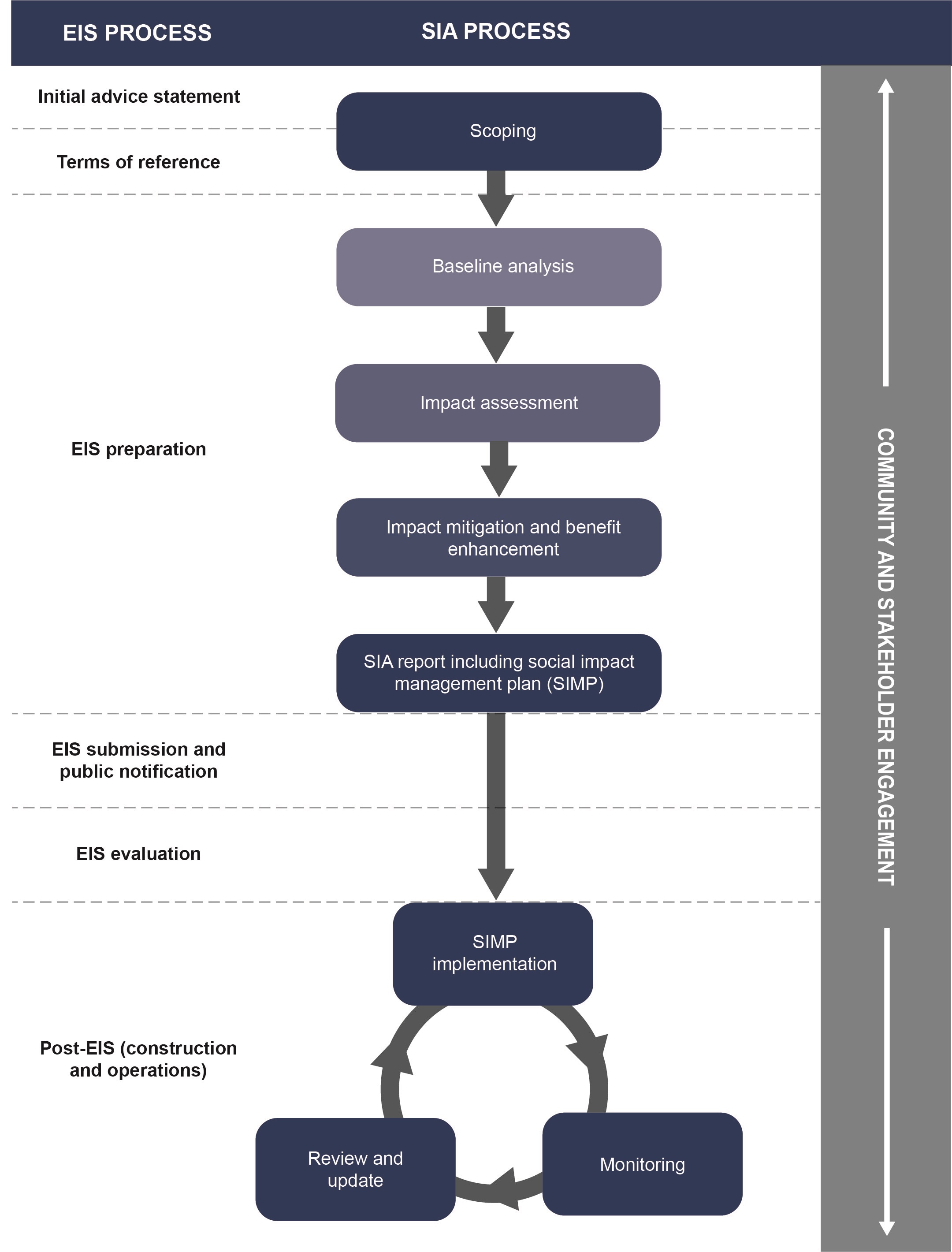
The SIA process must address:
- community and stakeholder engagement
- workforce management
- housing and accommodation
- local business and industry procurement
- health and community well-being.
It must also be integrated within the EIS process.
To understand the assessment process better you can:
- read the social impact assessment guideline (
 740.6 KB) for:
 - what a SIA must include
- how to identify and assess social impacts
- managing and monitoring social impacts
- read the SIA supplementary material ( 1003.5 KB) to help prepare a SIA. The document is designed for proponents and practitioners but can also help communities to understand the process and expectations of a SIA.
The SIA guidance material generally applies to all coordinated projects and a specific statutory instrument for resource projects (including EP Act resource projects in the EIS process). In 2025 the SIA process was also made statutory under the Planning Act 2017.
Engagement with communities and stakeholders is a vital part of the process to:
- understand who is likely to be impacted and how
- understand the affected communities
- identify and assess potential social impacts
- develop management measures to mitigate adverse impacts and enhance benefits
- support monitoring and reporting.
Project owners may want to include a range of people from professional and academic backgrounds to be part of their SIA study team. Team members should have a demonstrated understanding of SIA practice, applicable social research methods and associated community and stakeholder engagement approaches.
When the SIA is completed, the outcomes should be documented in a SIA report which is released for public comment with the project’s EIS.
The Coordinator-General makes a decision about the project, and can set conditions, as part of the assessment and approval process. The social impact management plan and reporting on it supports ongoing compliance .